.svg)

Material Does Not Become an Idea Until Something Governs Its Inclusion

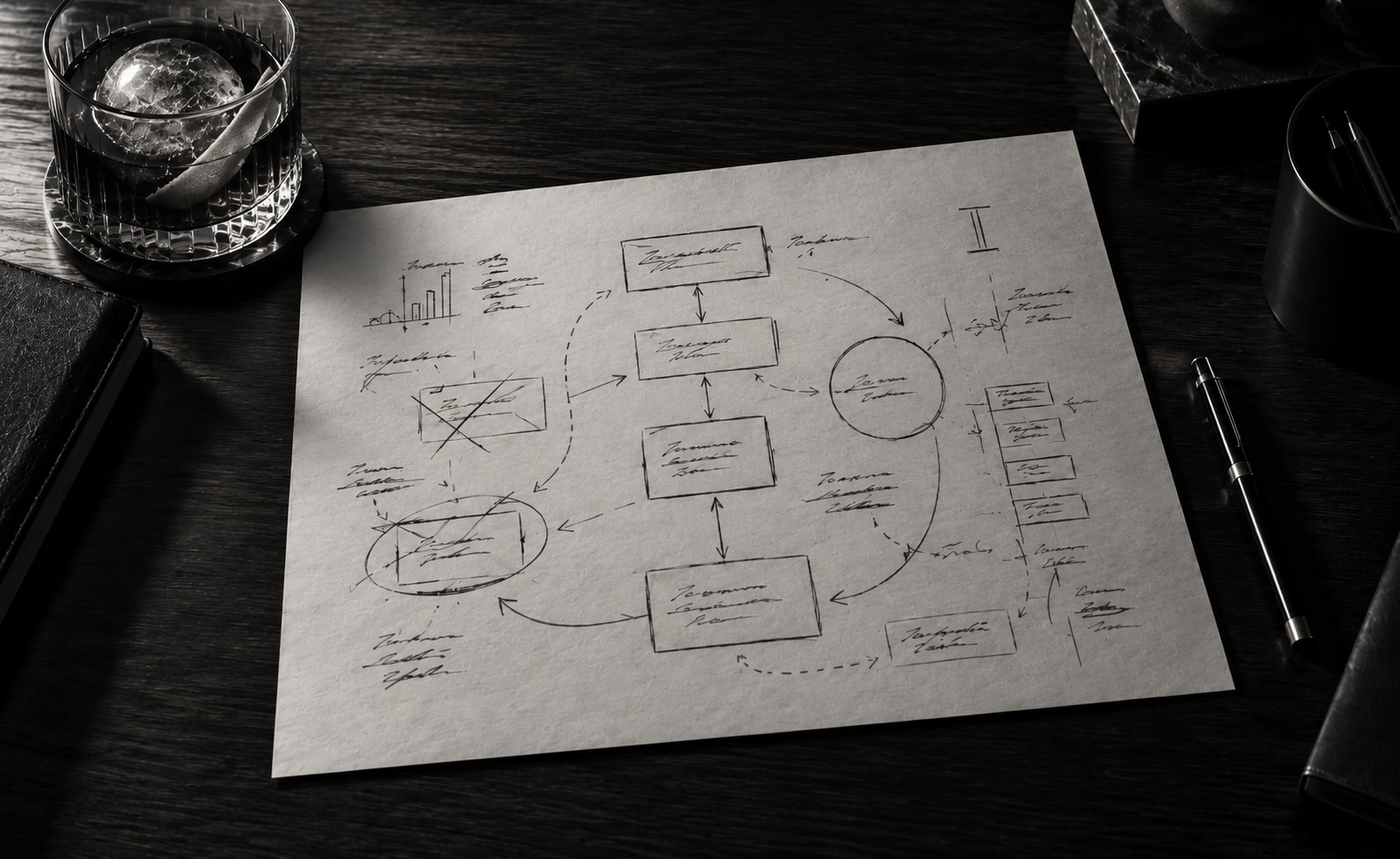
Material can gather around a subject for a long time without becoming an idea. Notes accumulate. Examples appear to reinforce one another. Stories share a mood. Observations point toward the same territory. Because the material feels related, it can create the impression that a coherent thought has already formed.
Relation is not coherence.
A collection may have a recognizable subject and still lack any principle that determines why one piece belongs beside another. The material might all concern creativity, risk, performance, identity, or decision-making. Those labels establish a field of interest. They do not establish an idea. A subject can admit almost anything associated with it. An idea cannot.
Something has to govern inclusion.
I do not mean that every developed idea must begin as a perfect thesis sentence. The governing force may first appear as a distinction, a contradiction, a pattern, or a suspicion that one explanation is inadequate. It may remain provisional while the material is being examined. But at some point, the material must become answerable to more than proximity. There must be a reason this observation is present, that example is absent, and another piece appears only after a distinction has been established.
Without that reason, arrangement is cosmetic. Material can be grouped, labeled, shortened, and placed in an appealing sequence while remaining conceptually ungoverned. The result may look finished because it has an opening, a middle, and an ending. It may even sound persuasive at the sentence level. Yet its parts are held together by topic rather than argument.
A governing idea changes the status of the material. Before it exists, each piece is simply available. After it exists, each piece has a function.
One detail may establish the problem. Another may distinguish two conditions that are usually confused. A third may complicate the initial claim. A story may give the abstraction a recognizable form. A counterexample may reveal the boundary within which the claim remains true. Material becomes structural when its presence affects the reader’s ability to receive the thought as intended.
This is why relevance is never an intrinsic quality. A fact is not relevant in isolation. It is relevant to something.
The same example can be essential to one argument, incidental to another, and distracting in a third. Its vividness does not determine its place. Neither does the effort required to discover it. Material does not earn inclusion because it is true, interesting, memorable, or difficult to abandon. Those qualities may explain why we are attached to it. They do not explain why it belongs.
Editorial judgment begins when attachment loses its authority.
That judgment is often mistaken for reduction. A draft contains too much, so the apparent task is to make it shorter. But removing material without a governing principle only produces a smaller collection. It does not produce a clearer idea. The central difficulty is not deciding how much to cut. It is deciding what the material is serving.
This distinction matters because abundance can conceal indecision. When the governing thought remains uncertain, additional material feels protective. Each example seems to improve the chances that the reader will understand. Each qualification appears to prevent misinterpretation. Each story seems to add weight. The draft expands because no individual part carries a defined burden.
More explanation then becomes a substitute for conceptual commitment.
A governing idea imposes a different discipline. It creates criteria that material can fail. That failure does not mean the material lacks value. It means value alone is insufficient. A compelling passage may belong to another idea. A useful distinction may require an argument that the present one cannot support. A story may be meaningful while directing attention toward the wrong center.
Exclusion is not a verdict on quality. It is a judgment about relationship.
I think this is one reason people resist governing ideas. Governance appears to narrow possibility. Once the idea becomes specific, some material must remain outside it. The broad subject felt generous because it permitted many associations. The developed idea feels more severe because it demands that associations justify themselves.
Yet an idea acquires force through this severity. If nothing can be excluded, the supposed idea has no edge. It names an area but does not organize thought within it.
A phrase such as “the importance of preparation” may describe a concern, but it governs very little. Almost any material about effort, planning, rehearsal, discipline, uncertainty, or performance could be placed beneath it. The phrase provides a container without establishing a relationship among its contents. It tells us where to look but not what to see.
A more exact proposition creates consequences. If preparation is understood as the work that protects a performance from preventable uncertainty while preserving room for discovery, the material now faces pressure. Examples of rigid control may no longer function as evidence of preparation. Rehearsal may need to be distinguished from repetition. Improvisation may belong, not as preparation’s opposite, but as one of its intended outcomes. The idea reorganizes the meaning of the material rather than merely naming its shared subject.
That reorganization is the intellectual work.
The governing idea does not sit above the material like a caption. It alters the role each part can play. Evidence that looked central may become contextual. A secondary observation may become the hinge of the argument. Two examples that once seemed repetitive may reveal an important distinction. Another example may have to disappear because it proves a different point, even if it proves that point beautifully.
This is also why coherence should not be confused with uniformity. A governed argument does not require every piece of material to say the same thing. If it did, one example would be enough. Coherence comes from the intelligible relation of the parts to the governing thought, not from their agreement with one another.
Contradictory material may belong because it tests the claim. An exception may define the limit beyond which the idea should not travel. A qualification may prevent a useful distinction from hardening into a false binary. Tension can be structural. What matters is whether the tension develops the idea or merely delays commitment to it.
An argument becomes weak when every contradiction is removed, but it also becomes weak when every contradiction is included. The first approach protects the claim from scrutiny. The second refuses to decide what kind of scrutiny matters. A governing idea must be open enough to encounter resistance and exact enough to determine which resistance changes it.
Governance, then, is not permission to force material into obedience. A thesis can become another form of disorder when it is treated as untouchable. If substantial material repeatedly fails to fit, the problem may not be the material. The governing thought may be incomplete, falsely drawn, or too broad to produce meaningful criteria.
The relationship between material and idea is recursive. A provisional idea selects material. The selected material exposes weaknesses in the idea. The idea is revised, which changes what belongs and how it functions. Structure emerges through that exchange. It is not added after the thinking has concluded because the thinking has not concluded until those relationships hold.
This process differs from confirmation. Confirmation asks the material to support a conclusion already protected from revision. Governance asks the material to become intelligible within an argument that remains accountable to what it encounters. The difference is not whether material is excluded. Both processes exclude. The difference is whether exclusion clarifies the idea or merely shields it.
A sound governing idea can explain its omissions without pretending they do not exist. It does not need to absorb every adjacent concern. It knows the difference between what would deepen the argument and what would create another argument. That boundary is not a failure of comprehensiveness. It is evidence that the thought has acquired a definite form.
The boundary also determines sequence. Once the role of each part is understood, order stops being a matter of variety or momentum. Some material must precede other material because it changes how that later material can be interpreted. A distinction may need to appear before an example, or the example will reinforce the very confusion the distinction is meant to correct. Context may need to be delayed because introducing it too early would make a secondary concern seem central.
Sequence is therefore governed inclusion across time. It decides not only what belongs, but when its meaning can be carried.
This exposes the limits of verbal polish. A sentence can be elegant and still occupy the wrong position. A transition can connect two paragraphs whose ideas should not be connected. A memorable story can produce emotional continuity while weakening conceptual continuity. Language can smooth over an unresolved relationship, but it cannot resolve it.
The danger is that fluency makes incoherence easier to tolerate. When the prose moves well, the reader may not immediately notice that the argument has changed its standard of relevance. A story is admitted because it is moving. A fact is included because it is surprising. A qualification appears because it sounds responsible. Each part succeeds locally while the whole loses definition.
Conceptual coherence requires a more demanding question than whether each part works. The parts must work for the same developed thought.
This does not mean every idea must be compressed into a slogan. A slogan often lacks the discriminating power required to govern anything. It can be memorable precisely because it leaves its terms undefined. Many kinds of material can gather beneath it without friction. That makes the phrase portable, but not necessarily precise.
Useful compression preserves the relationships that give the idea its meaning. It reduces repetition, not necessary distinction. It removes surplus explanation, not the context that allows the claim to remain true. A governing idea may eventually be stated in one sentence, but the sentence matters because it contains consequences. It permits some interpretations and refuses others.
The strongest evidence of an idea is not that it can attract material. Subjects do that easily. The stronger evidence is that it can assign different material different roles, reveal why certain parts cannot be collapsed, and identify what can be removed without changing the thought.
A developed idea leaves material behind. Some of that material remains true, interesting, and available. It simply no longer belongs to this argument. That remainder is not waste. It is evidence that judgment occurred.
Where nothing can be left behind, nothing has yet taken command. There is only material waiting for a reason to belong.
WHAT THEY BUILT.
WHY IT MATTERED.