The Best Ideas Usually Begin as Something Else

People often arrive convinced they already know what their idea is.
Sometimes they do.
Often they have brought me the story sitting on top of it.
This is an important distinction.
A powerful experience can feel like an idea because it carries emotion.
A career accomplishment can feel like an idea because it carries authority.
A personal transformation can feel like an idea because it changed the person who lived it.
But an experience is not automatically an idea.
Neither is a story.
Neither is expertise.
They are material.
The idea is often hiding underneath them.
That is why some of the most interesting work begins with something that appears to be about one subject and slowly reveals itself to be about another.
Someone thinks the idea is about failure.
After enough examination, it may actually be about permission.
Someone thinks the idea is about resilience.
The deeper idea may be about containment.
Someone thinks the idea is about kindness.
Eventually we discover they are really examining the environment that determines whether kindness is possible.
The first description was not wrong.
It was incomplete.
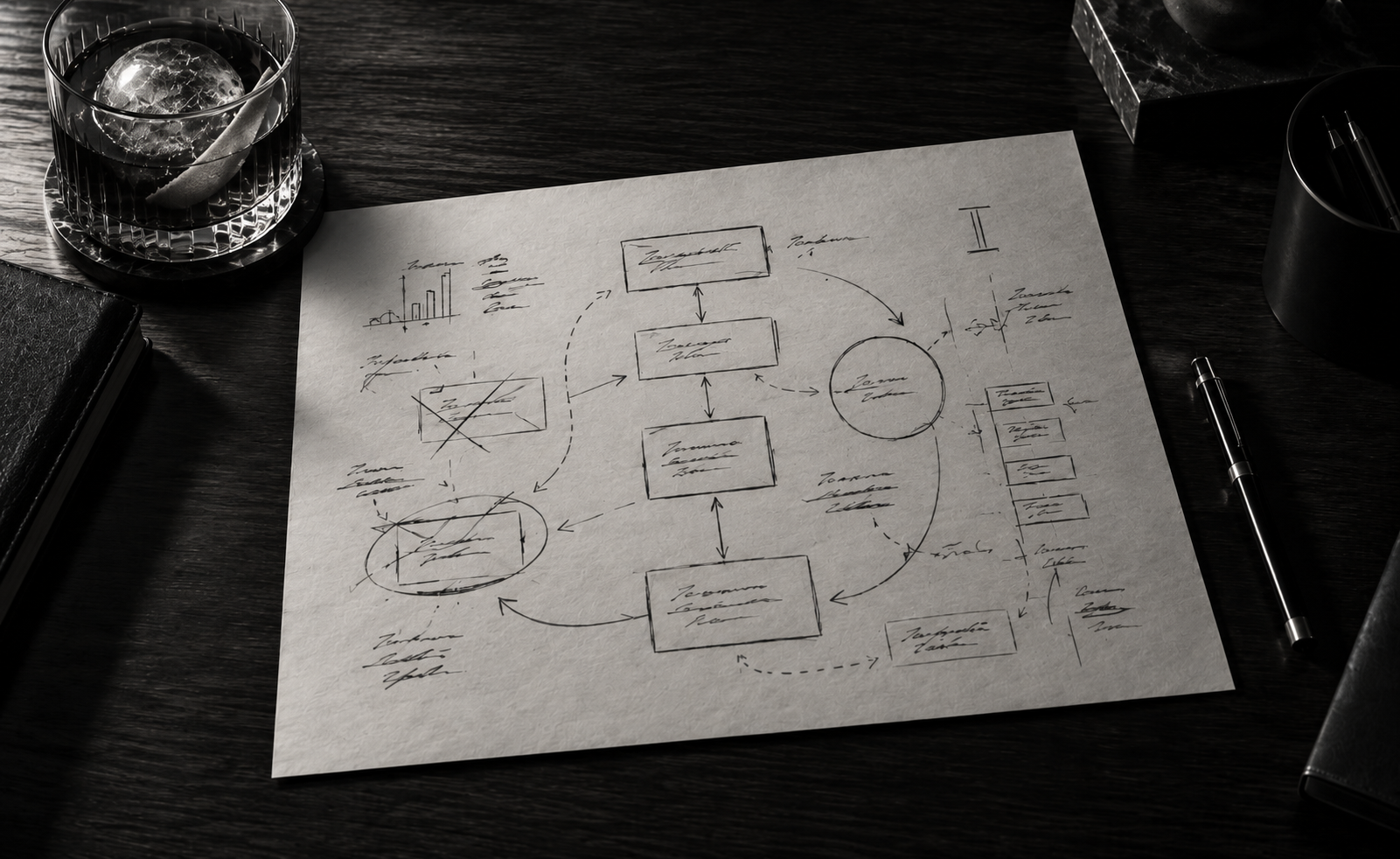
Discovery has to come before architecture.
You cannot build the structure until you know what you are building around.
And you cannot know that until you are willing to interrogate the material.
Why does this story matter?
What changed because of it?
What did you believe before?
What do you believe now?
Where is the tension?
What is surprising?
What would another intelligent person disagree with?
What keeps appearing across stories that initially seem unrelated?
Eventually a pattern begins to emerge.
Sometimes it appears in a sentence.
Sometimes in a contradiction.
Sometimes in something the person says casually and then immediately moves past.
That moment interests me.
Because people frequently move quickly past the thing that is most original to them.
They have lived with it so long that it no longer feels unusual.
What sounds obvious to the expert may be revelatory to everyone else.
That is one reason outside perspective can matter.
We are not always the best judges of what is distinctive inside our own experience.
We know which moments were dramatic.
We know which accomplishments were impressive.
We know which stories people usually ask us to tell.
But the strongest idea may be hiding somewhere quieter.
An observation.
A tension.
A phrase.
A decision nobody else thought was important.
The architecture begins after that discovery.
Once the central idea has been identified, everything has to answer to it.
Stories are no longer included simply because they are good stories.
Evidence is not included simply because it demonstrates expertise.
Language is not kept simply because it sounds clever.
Every element has a job.
Does this clarify the idea?
Does this advance it?
Does this challenge it?
Does this make it more memorable?
Does this earn its place?
That last question is ruthless and useful.
Because ideas tend to become weaker when we ask them to carry too much.
The instinct is understandable.
People want the audience to know everything.
Everything they survived.
Everything they learned.
Everything they accomplished.
Everything they researched.
But architecture requires load-bearing choices.
A building cannot be every shape.
An idea cannot be every thought.
Structure requires commitment.
That is why the idea you eventually build may look different from the one you first brought into the room.
That is not failure.
It is usually evidence that discovery occurred.
The original thought opened the door.
The work revealed what was behind it.
There is humility required in that process.
You have to be willing to let the material tell you something you did not already know.
You have to be willing to discover that your favorite story is not the center.
You have to be willing to find an idea more interesting than the one you arrived determined to prove.
That is where architecture becomes possible.
Not when everything has been added.
When the right thing has finally been found.
The best ideas do not always arrive looking like ideas.
Sometimes they have to be uncovered before they can be built.
WHAT THEY BUILT.
WHY IT MATTERED.